
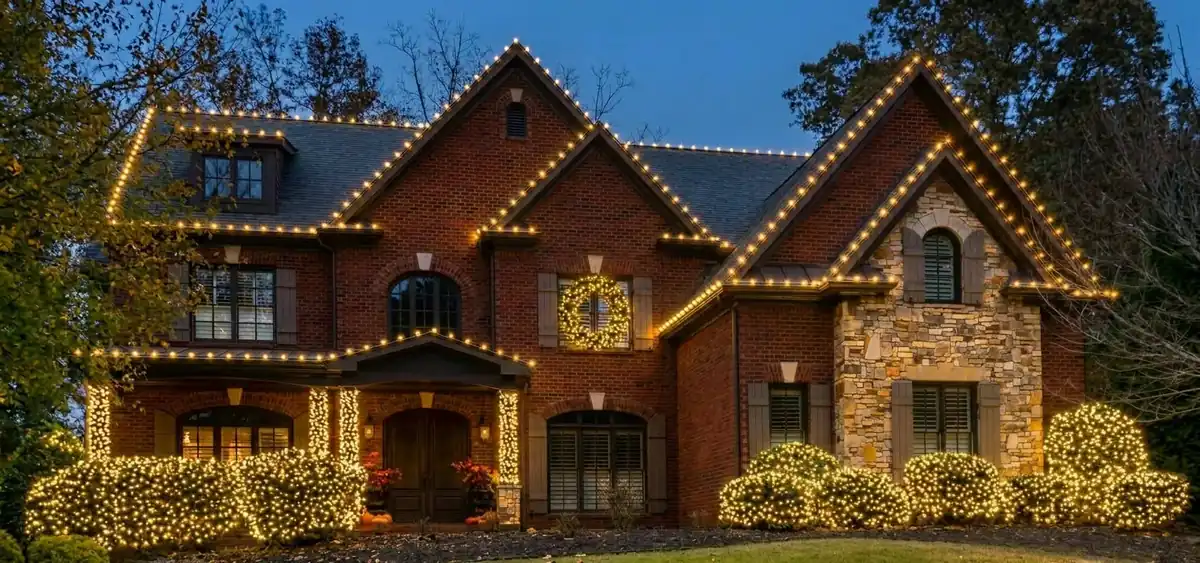
Visual Holiday Lighting Planning
Holiday Shine uses visual examples to help Kennesaw property owners discuss rooflines, entries, trees, landscape zones, spacing, and overall display direction. The images on this page are Holiday Shine lighting examples. They are presented as design references unless a separate case study has verified the project details, so customers can browse ideas without unsupported location or customer claims.
Holiday Shine Lighting Examples
Holiday Lighting Design Examples
The images below are Holiday Shine lighting examples presented for design and planning reference. Customer names, street addresses, dates, and project details are only presented when they have been verified.

Roofline hierarchy and clean edge spacing
Use this example to study roofline hierarchy: note which eaves or peaks carry the brightest outline, where the line starts and stops, and whether the entry needs a secondary accent to keep the facade balanced.

Coordinated roof peaks and entry emphasis
Use this example to compare spacing and color consistency across adjacent architectural sections. On the actual property, the estimate should identify which roof edges or facade lines are priorities rather than copying the photograph as a fixed package.

Garage and entry balance
Use this example to evaluate how an entry, porch, or garage can support the main roofline without becoming a competing focal point. The customer can point out the element they want emphasized when sending property photos.

Consistent color direction across the facade
Use this example to discuss landscape depth. Trees, shrubs, and pathway accents should connect visually to the building while preserving normal access and remaining clearly identified as part of the approved scope.

Architectural lighting used as the primary visual layer
Use this example to compare restrained and layered lighting. A property does not need every available surface illuminated; selective coverage can make the strongest architectural features easier to read from the primary viewing angle.

Roofline and landscape zones planned as one composition
Use this example to identify a preferred overall mood—classic, colorful, symmetrical, architectural, or landscape-led—then translate that preference into the customer’s real roofline, entry, tree, and access conditions during the estimate.
Use Gallery Images to Define the Display Hierarchy
A gallery is most useful when it helps a property owner describe what they like rather than when it functions as a collection of unrelated photos. Start by identifying which features carry the design: the main roofline, peaks, entry, garage, trees, shrubs, walkways, or commercial frontage. Then note whether the display feels restrained, layered, symmetrical, colorful, or primarily warm white.
Those observations give Holiday Shine a better starting point for the estimate because they translate a visual preference into specific property zones and design choices.
Separate Architectural Lighting From Landscape Accents
Roofline and facade lighting establish the shape of the building. Trees, shrubs, pathway accents, wreaths, and garlands can add depth, but they should support the main composition rather than compete with it. On a smaller property, one or two landscape zones may be enough. On a larger property, the design can use repeated accents to connect several architectural sections.
The approved quote should identify which elements are included so the visual plan and service scope remain aligned.
Ask for Project Context, Not Just a Similar Photo
Two properties can look similar in a photograph but require different access, roofline lengths, tree coverage, or installation methods. A gallery image should therefore be used as inspiration, not as a promise that the exact design or cost can be copied onto another property.
When requesting an estimate, send photos of the actual property and mention which gallery characteristics you want to borrow. That lets the plan respond to the real architecture instead of forcing a prebuilt package onto it.
Real Case Studies Require Verified Details
The strongest local project case studies include verified images, a general project location, lighting scope, property type, design goals, and a short explanation of the solution. Holiday Shine should publish those details only when the information is real and approved for public use. Holiday Shine publishes project case studies only when the images and project details are genuine and approved for public use.
As verified case studies are added, they can give customers more detailed examples alongside this gallery and the related residential and commercial service guides.
Connect Visual Inspiration to the Right Service Page
Homeowners can continue to the residential installation page. Businesses and property managers can review commercial holiday lighting. If the desired look includes a permanent roofline system, compare the permanent lighting guide before requesting the estimate.
The cost guide explains why the actual property and approved display zones matter more than a generic per-photo price.
From Visual Reference to Seasonal Service Scope
A gallery choice becomes useful only after it is translated into the customer’s actual property. The estimate should identify which rooflines, entries, trees, landscape areas, or commercial frontage borrow from the reference image and which elements are not included. That written scope is also the reference for Holiday Shine’s included in-season maintenance and January removal of the installed seasonal display.
Gallery images should never be used to infer an identical price, property condition, or service requirement. The real site and approved design remain the source of truth.
Common Questions
Kennesaw Christmas Lighting Gallery and Design Planning FAQs
Are the gallery images exact packages I can order?
No. Gallery imagery is used for design reference. The actual layout and estimate should be based on your property, access, architecture, and approved display zones.
Can I send a gallery image with my quote request?
Yes. Point out the roofline, color direction, landscape treatment, or other visual feature you like, and also send photos of your actual property.
Will Holiday Shine publish customer addresses in case studies?
Project details should be published only with appropriate approval. A case study can usually provide useful local context without exposing a precise customer address.
Can businesses use the same design ideas?
Yes, but commercial properties also need operating-hour, customer-access, visibility, and property-manager considerations that may change the installation plan.
Where can I see verified project case studies?
Verified case studies appear on this gallery only after genuine project records and images are approved for public use.
Property-Specific Planning
Request a Holiday Shine Estimate
Send photos of the actual property and point to the gallery characteristics you want to borrow, such as roofline hierarchy, entry emphasis, landscape depth, or color direction. Holiday Shine can then translate the visual reference into a property-specific seasonal scope.